
How Anthropic is using Claude Code
They’re running their entire company on it.

Anthropic isn’t just selling Claude Code
And what they’ve learned internally is more useful than any product announcement.
Dario Amodei confirmed in late 2025 that AI is writing the majority of code across many Anthropic teams. Boris Cherny, the creator of Claude Code, has not edited a single line by hand since November 2025. By early 2026, Claude Code accounted for roughly 4% of all public GitHub commits, with daily active users doubling month over month.
This is not a pilot program. This is what an AI-native organization actually looks like from the inside.
What changed across the org, and how fast
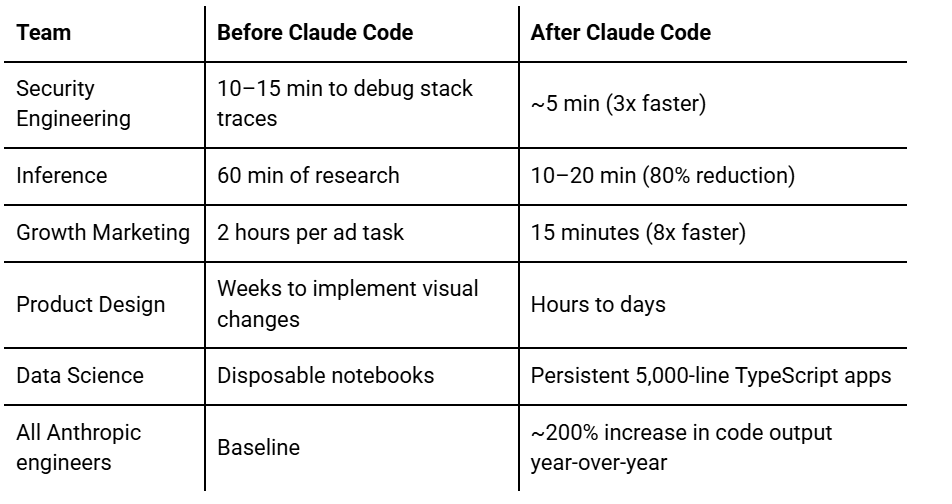
The numbers are worth sitting with. Security Engineering cut debugging time from 15 minutes to 5. The Inference team reduced research and onboarding from 60 minutes to 10. Growth Marketing compressed 2-hour tasks to 15 minutes. Data Science went from throwaway Jupyter notebooks to persistent 5,000-line TypeScript applications, built by engineers with minimal JavaScript experience.
The Legal team built a working phone tree system and a predictive text accessibility tool in approximately one hour. A lawyer, with no engineering background. Their internal reaction captures the broader shift: “Holy crap, I’m a developer.”
That is not a productivity story. That is a skills and roles story.
What this means for senior engineers
Jack Clark, Anthropic co-founder, said it directly: the value of junior engineering talent inside Anthropic is now “a bit more dubious.” Basic implementation is increasingly automated. What is gaining value is judgment, architectural taste, and the ability to evaluate what AI produces for correctness, security, and coherence.
The bottleneck in software development is no longer writing code. It is deciding what to build, reviewing output at scale, and maintaining architectural integrity across codebases growing at 200% per year. Anthropic’s own RL Engineering team reports that autonomous Claude Code tasks succeed on the first attempt roughly one third of the time. The inspection function is now the critical path.
Senior engineers who can set direction, catch edge cases fast, and reject bad output confidently are becoming more valuable. Those whose primary edge was execution speed are being repriced.
What this means for C-level leaders
The productivity opportunity is real but incomplete without governance. Claude Code’s sandboxing is off by default. Three critical security vulnerabilities were disclosed and patched in 2025 and 2026, all involving MCP configuration exploits that could allow remote code execution. Organizations running Claude Code in production without explicit sandboxing requirements, MCP allowlists, and credential scope limits are carrying security debt they may not have accounted for yet.
The workforce reshaping has already begun and it moves faster than most hiring cycles. The teams generating the highest returns at Anthropic are not just engineering teams. Legal, Finance, and Marketing are producing work that previously required engineering resources or simply did not get done. Leaders who extend AI tooling only to technical staff will leave significant leverage on the table.
Boris Cherny put the bigger shift plainly: the factory floor is producing three times as many cars. If the inspection team does not grow and develop better tools, you ship defective cars at scale.
The question worth asking in your next leadership meeting
Anthropic is already a prototype of the organization most tech companies are trying to become. The gap between watching that from the outside and building it deliberately inside your own org is closing faster than most planning cycles assume.
Where in your organization is the bottleneck still execution, and where has it quietly shifted to judgment?